
Overlap of Game Mechanics and Themes in Maddy Makes Games’s Celeste
The advent of independent game creators in recent years has resulted in increasingly personal, intimate game stories. The creative control that comes with being directly involved in several aspects of the production of a game also results in something else: a direct link between the game’s story and themes, and its fundamental mechanics. In many of the most popular Indie games released in the last decade and beyond, not just the games focused on in this article, examples of this can be seen: Hades’ roguelike respawn mechanic meshes perfectly with its source material’s bizarre relationship with mortality; Undertale’s core themes of choice between pacifism and violence are reflected in its core combat system, where puzzles can be solved to avoid combat entirely. This article focuses on the usage of the “Golden Feather” in Celeste.
Celeste
Celeste is a game about climbing a mountain. You’re not a mountain climber, or a hiker, or some sort of daredevil thrill-seeker. You’ve never done this before, and you don’t really have a reason to, anyway. Nonetheless, you’re climbing a mountain. In media, a mountain is often symbolic of something; a challenge or obstacle, a mental block, something insurmountable. To Madeline, the young woman tasked with climbing Celeste Mountain not for money or fame or any tangible reward, but for herself, it is all of these things. It serves as a physical barrier between her and what she wants to achieve, a manifestation of her depression, her dysmorphia, her debilitating social anxiety, all the terrible things she believes about herself. The mountain is the old lady who laughs you away when you begin the climb, the warning signs posted around the first level and the memorial which reminds you of those who came before you, just to perish on the climb.
The first level called “Old City” is perfect at setting the tone for Madeline’s journey up Celeste Mountain. She could hardly feel less prepared for the climb. Despite this, a comforting face is not far. It is in this chapter that the player is introduce to Theo, a recurring character through your hike that serves an important role in Madeline’s story. Theo is host to a whole array of issues, he’s obsessed with his image and perception to an unhealthy degre, but to Madeline his confidence is comforting, making her feel better and less endangered whenever they meet. Theo is a photographer/hiker who came to Celeste Mountain to connect with his past and take some nice photographs. To the player, Theo is an utterly relaxing presence. He’s confident, aware and gentle. To Madeline, who struggles intensely with her anxieties throughout the story, he is a refuge from the dangers of the mountain.
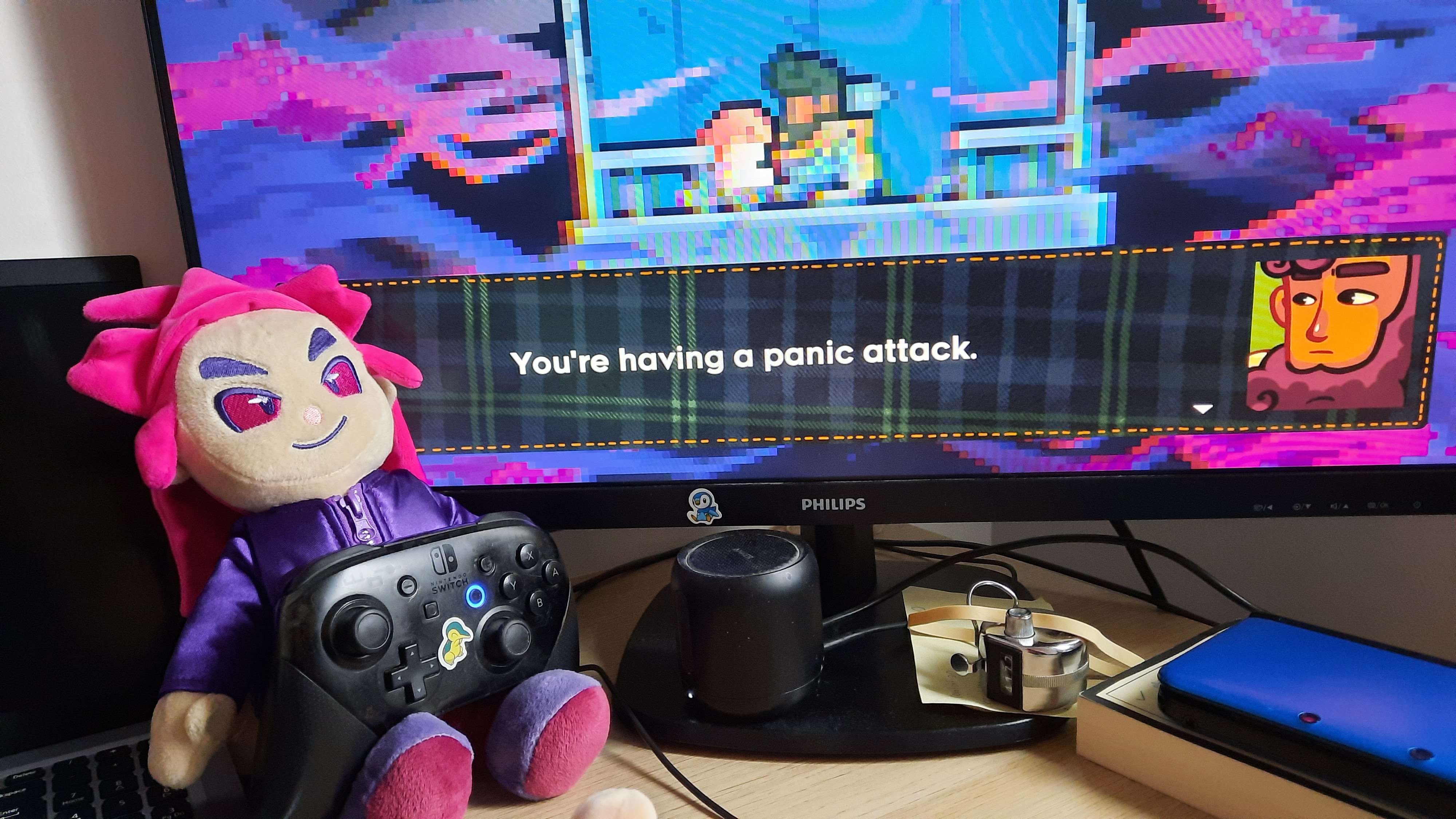
You meet Theo again at the end of the game’s fourth chapter, Golden Ridge. The level itself is full of violent winds and bottomless falls off of cliff faces. At the end, Madeline comes across a beaten-looking, old gondola, which creaks in the wind and faces over yet another cliff face without end. Theo arrives, falls on his face, and agrees to help Madeline operate the gondola. After he wrenches the rusted lever forwards, the machine lurches to life, and the creaking metal flies past the cliff immediately suspending Madeline and Theo above an indeterminable length of frigid mountain air, and little else. Theo decides to take a selife. Madeline freaks out. The gondola stalls, and “Badeline” (a major character in the story, here interpreted as a manifestation of Madeline’s anxiety and dysphoria) appears. She brings with her writhing tentacles, a dark shadow over the screen and a screeching, grating synth soundtrack. Madeline is having a panic attack.
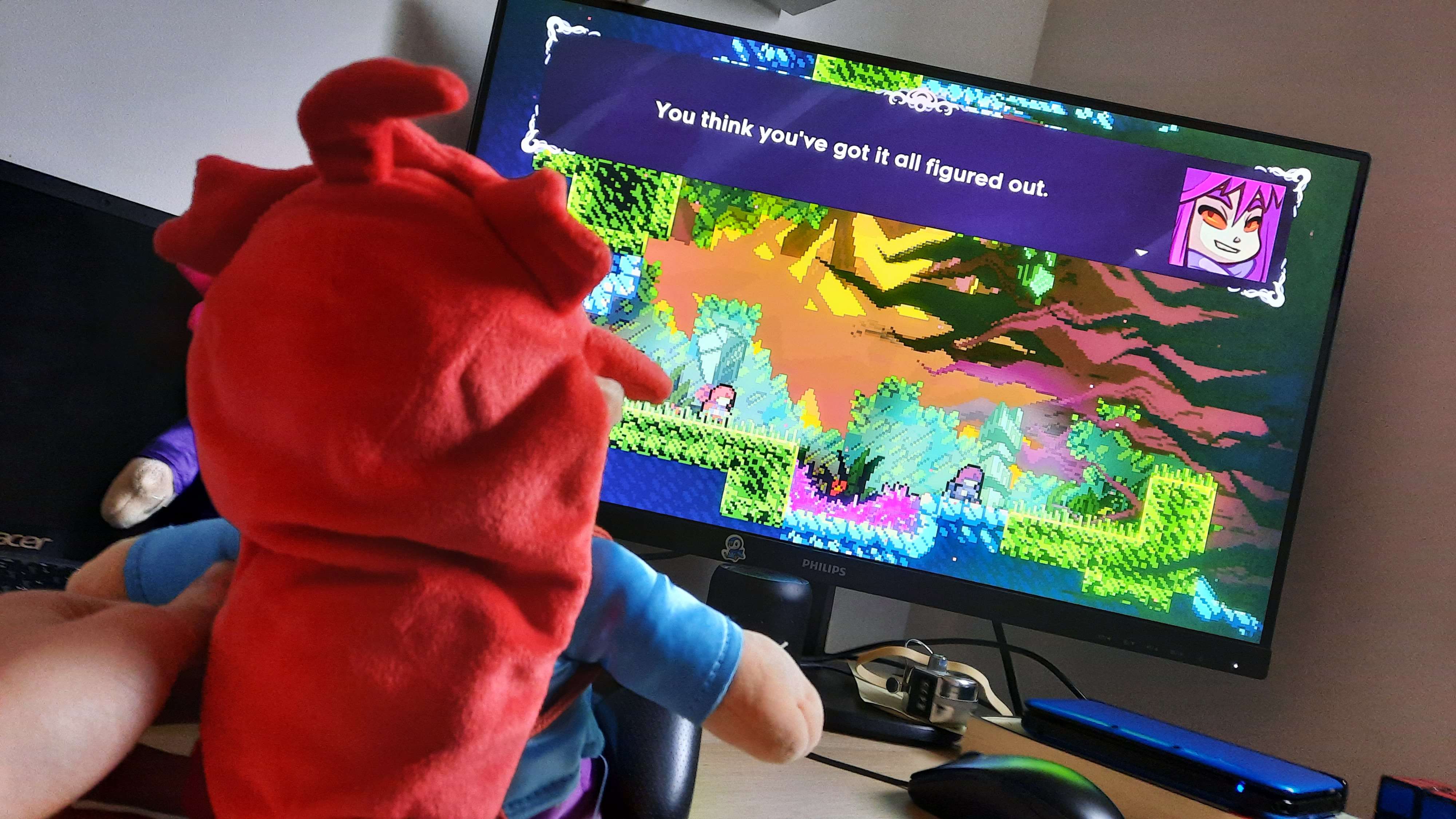
Theo says something about his granddad, and then his textbox disappears. The screen dims, and glowing white text appears. The game is now talking directly to the player, using Theo’s voice.
Just breath slow and steady, in and out.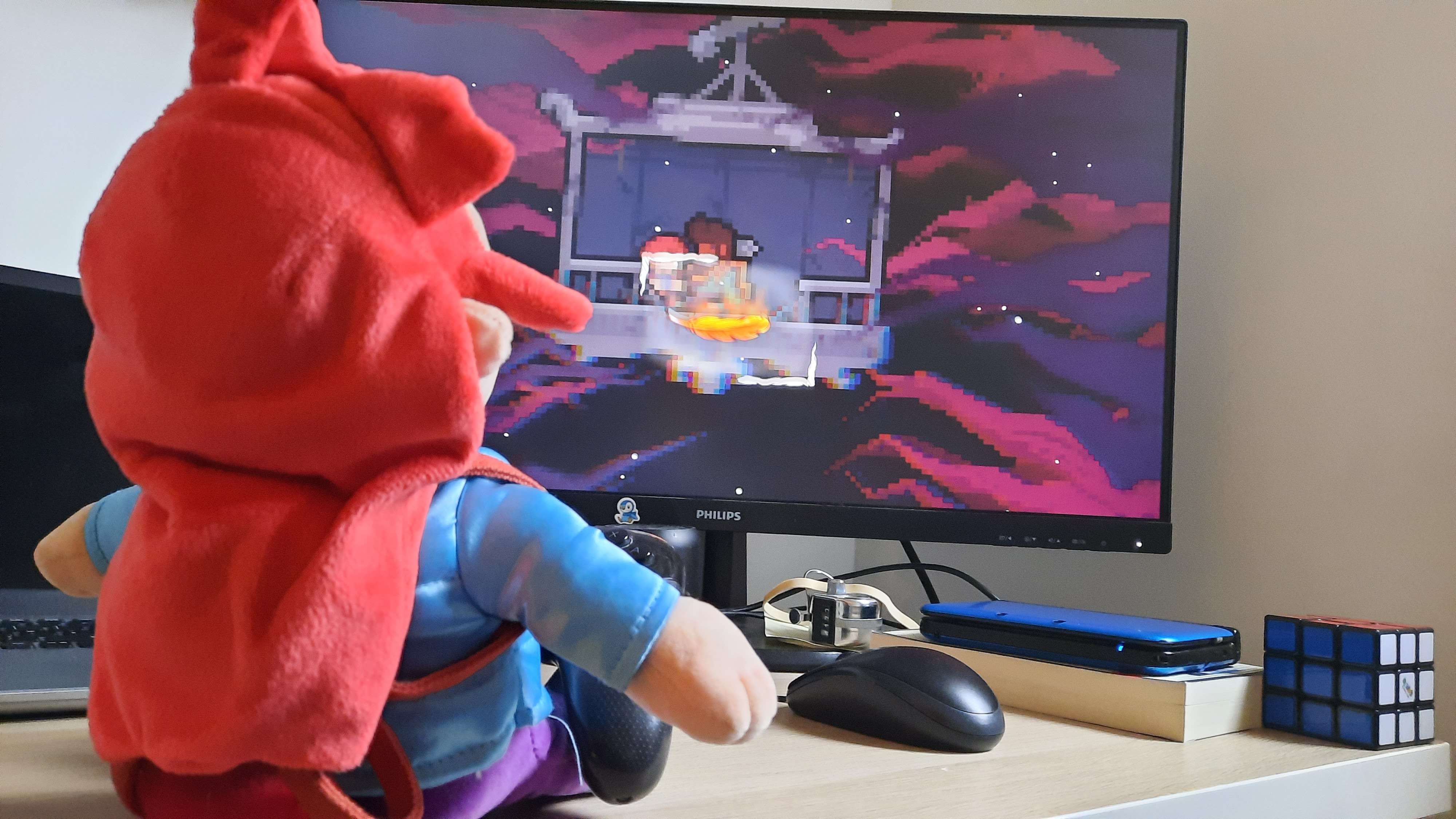 The player presses down a button, and the feather rises. They release it, and it falls. Rises. Falls. The music slowly begins to dim. The screen begins to brighten. Madeline recovers her senses, and the player releases all the anxiety and tension they had barely noticed was building in themselves. Through an incredible combination of game design and storytelling, the player was completely immersed in the experiences of these fictional characters. The golden feather is used later in the game, further exploring Madeline’s anxieties and the limits of her tactics to manage them. The gondola returns safely, Madeline can finally catch her breath, and Theo ended up with a pretty good selfie after all.